
Talk to Strangers in South Asia
India, Pakistan and Bangladesh are some of the busiest random-chat countries in the world, and they are online late. This guide covers the languages you will hear, the hours each country comes alive, and how to use country preferences without expecting guarantees.
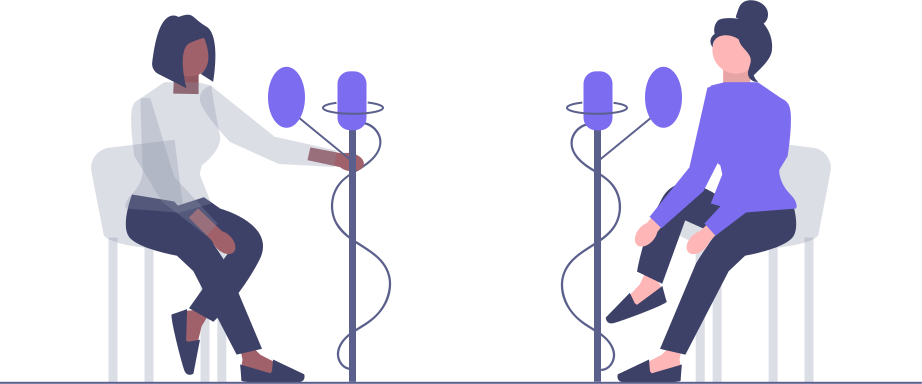
What chatting in South Asia is like
What sets South Asia apart on TalkLive, in short.
Speak, do not type
Voice skips the script-switching problem entirely. Say it in Urdu, Hindi, Bengali or English.
One time-zone block
All three countries share the same evening, so the late-night queue is genuinely busy.
Shared languages
Hindi and Urdu speakers understand each other in casual speech, across the border.
English practice
Many students use calls to practise spoken English with people outside their own country.
Mobile-friendly
Audio-only calls use far less data than video, which matters on prepaid mobile plans.
Anonymous by default
No phone number or real name is needed. Share only what you choose to share.
How to meet people from South Asia
Country preferences shape who you are likely to meet. They never guarantee it.
Open TalkLive
It runs in any modern browser on phone or computer. Nothing to install, no account needed.
Set country preferences
Choose countries from South Asia in settings. Free accounts can choose up to two per list.
Pick the right hour
Go online during local evening hours, listed for each country below, when the most people are waiting.
Say hello
Open with a greeting in the local language - it is the fastest way to make a stranger smile.
Random chat across South Asia
South Asia is where voice chat makes the most obvious sense. Hindi, Urdu, Bengali, Tamil and Punjabi are all written in different scripts, and typing any of them on a phone keyboard is slower than simply saying what you mean. That is the single biggest reason voice-first matching works so well across the region: people speak the way they already talk at home, switching languages mid-sentence without fighting an input method.
The region is also one time-zone block. India runs on UTC+5:30, Pakistan on UTC+5 and Bangladesh on UTC+6, so all three countries are awake at roughly the same time. Evenings are busy, and the queue stays active long after midnight - later than almost anywhere in Europe or the Americas. If you are in Europe, South Asian late evening overlaps with your late afternoon; if you are in North America, it lines up with your morning.
Hindi and Urdu are mutually intelligible in everyday speech, which means an Indian and a Pakistani caller can usually hold a normal conversation without either switching to English. English remains the common fallback for everyone else, and for many students it is the reason they are on a call at all.
India
India is one of the largest sources of random-chat traffic in the world, and it is overwhelmingly mobile: cheap data, a phone per person, and a strong preference for voice over typing because switching keyboards between scripts is a nuisance. That is why voice-first matching lands well here - you speak Hindi, Tamil or English without fighting an input method. Evening is when the country comes online, after work and dinner, and it stays busy well past midnight.
Languages you will hear: Hindi (Namaste), English (Hello), Bengali (Nomoshkar) and Tamil (Vanakkam). Local time: UTC+5:30 (IST), busiest around 9pm - 2am IST. Common topics: cricket, films and music across four or five industries, exam and job prep and moving abroad.
Around India: Mumbai - the longest commutes in the country, which is exactly when a voice call beats typing; Delhi - a mix of Hindi, Punjabi and English in a single conversation is completely normal here; Bangalore - a tech workforce that keeps US hours, so its late-night users overlap with American afternoons; Hyderabad - Telugu and Urdu speakers in the same city, often in the same chat; Chennai - Tamil-first, with English used freely for anything technical; Kolkata - Bengali conversation culture - long, unhurried, argumentative in the friendliest way.
Pakistan
Pakistan has an unusually active late-night chat culture - traffic here peaks later than almost anywhere else, often past 1am. Urdu is the shared language across provinces even where it is nobody's mother tongue, so a random match usually finds common ground immediately. Voice matters more than text here for the same reason it does across South Asia: typing Urdu on a phone is slower than simply saying it.
Languages you will hear: Urdu (Assalam-o-Alaikum), Punjabi (Sat sri akal), English (Hello) and Pashto (Salam). Local time: UTC+5 (PKT), busiest around 9pm - 3am PKT. Common topics: cricket, university admissions, freelancing and remote work and food, endlessly.
Around Pakistan: Karachi - the country's largest city and the most linguistically mixed room you will land in; Lahore - Punjabi and Urdu switch mid-sentence and nobody comments on it; Islamabad - a student-heavy population that skews toward English practice; Faisalabad - a working city where late-night is genuinely late - 1am is not unusual.
Bangladesh
Bengali is the sixth most-spoken language in the world and badly under-served by chat platforms, so Bangladeshi users often find their best matches are other Bengali speakers in India, the UK and the Gulf rather than at home. Typing Bengali on a phone is slow enough that voice is the obvious default.
Languages you will hear: Bengali (Kemon achho?) and English (Hello). Local time: UTC+6 (BST), busiest around 9pm - 2am BST. Common topics: cricket, study and exams, working abroad and music and poetry.
Around Bangladesh: Dhaka - one of the most densely populated cities on earth, and its chat traffic is proportionate; Chittagong - a regional dialect distinct enough that Dhaka speakers notice it immediately.
What country preferences can and cannot do
TalkLive estimates each caller's country from their network connection and uses your preferences to favour matches from the countries you choose. It does not match by city, does not verify anyone's location, and cannot promise a match from a given country at a given moment - the live queue is whoever happens to be online. A VPN will also change the country you appear to be in.
Whoever you meet, the same rules apply everywhere: TalkLive is for adults only, you can leave any call instantly, and you can block or report anyone who breaks the community guidelines. See the safety centre for what TalkLive protects and what it cannot.
Frequently asked questions
Can I choose to talk only to people from India or Pakistan?
You can set country preferences in the app. They are preferences, not guarantees: if nobody from your chosen countries is waiting, TalkLive may match you with someone else rather than leave you waiting indefinitely. The free plan allows up to two countries per list.
When is South Asia most active?
Roughly 9pm to 2am in India and Bangladesh and 9pm to 3am in Pakistan. Pakistan peaks later than almost any other country on the platform.
Can I talk in Urdu, Hindi or Bengali?
Yes. Calls are ordinary voice conversations, so you can speak any language you and the other person share. The interface itself is also available in Urdu, Hindi and Bengali.
Can I pick a specific city like Karachi or Mumbai?
No. TalkLive matches by country preference, not by city, and it does not verify anyone's location. The city notes on this page describe the places, not a matching option.
Does voice chat use a lot of mobile data?
Much less than video. An audio-only call uses a small fraction of the data a video call does, which is why it works well on mobile connections.

Read more from the TalkLive blog
Guides
How Much Data Does Voice Chat Actually Use?
Real numbers for WebRTC voice against video and streaming, what a relay adds, and how long you can talk on a small mobile data plan.

Language Learning
How to Practice Speaking English Online for Free - With Real Humans
Apps teach you vocabulary, but only conversation makes you fluent. Here is how to practice speaking English online for free with real people, starting today.
Wellbeing
Need Someone to Talk to at 3AM? Here Are Your Real Options
It's the middle of the night, your mind won't stop, and everyone is asleep. The real options when you need someone to talk to at 3am, free.
Explore more ways to connect
TalkLive is one app with many ways to meet people. Jump into whichever fits your mood.

Say hello to South Asia
Set a country preference and join the live queue - voice or text, no sign-up.